

What You Don’t See Is What Makes the Building Possible
If you drive past the future Denton County Family Justice Center right now, you might see heavy equipment, piles of dirt, trenches and crews working across the site. To someone outside the construction industry, it can be hard to see how all that activity becomes a building.
Matt Humphries has a simpler way of explaining it.
“To outsiders, it just looks like we are digging holes and filling holes. In reality, we are burying money.”
Matt serves as DCFOF’s owner’s representative through Lincoln Property Company, helping guide the day-to-day construction process and protect DCFOF’s interests as the Family Justice Center moves from plans on paper to a campus built to serve survivors and their children.
He brings more than 30 years of construction experience to the project. After studying architecture and construction management, Matt began his career in the field as a superintendent, where, as he puts it, he helped “the rubber meet the road.” He later moved to the development side of the industry and into owner representation.
His connection to the Family Justice Center, however, began long before construction.
About eight years ago, Matt remembers sitting down with DCFOF Executive Director Toni Johnson-Simpson as she described her vision for bringing a Family Justice Center to Denton County. His mother’s service on the DCFOF Board provided a natural connection to the organization, but Matt says it was that conversation with Toni that changed things.
“She made me a believer that night. After that conversation, I wanted to be a part of this journey.”
Matt’s time and owner-representation services are being donated by Lincoln Property Company, an important contribution that gives DCFOF access to professional construction expertise while allowing more project dollars to go directly toward building the Family Justice Center.
Lincoln is one of a growing and diverse group of businesses, public entities, foundations, construction professionals, donors, and community partners bringing their expertise and resources to the project. The Family Justice Center is being built not only with dollars, but with donated expertise, relationships, and people willing to lend what they do best to the mission.
What’s Happening Underground?
Today, much of Matt’s attention is focused on work most people will never see once the Family Justice Center is complete.
Triton, DCFOF’s Construction team, is finishing installation of underground infrastructure that will serve the campus, including fire lines, domestic water and sanitary sewer. Work is also underway to bring natural gas to the site.
These systems may disappear beneath the ground, but they are essential to everything that will eventually happen above it. The underground utilities are like the lifelines for the future building. It provides the services, power/water/sever/gas/fire line that we use every day. You turn on a faucet, and it just works. We just don’t think about where it comes from.
Next comes preparation of the building pad. Crews will excavate, condition the soil to the moisture levels specified by engineers, compact it and test it to make sure the ground can properly support the building. Underground plumbing and electrical work will follow before work on the slab begins.
At the same time, crews will begin work on the fire lane. It may seem unusual to build emergency access before there is even a building, but the fire lane ensures emergency vehicles can safely reach the construction area as work progresses.
It is a good example of the sequencing behind a major construction project.
Before the walls can go up, a tremendous amount has to happen below and around them.
When the Ground Changes the Plan
Even with extensive planning, construction has surprises.
Before work began, geotechnical engineers drilled several borings across the site to understand the soil and subsurface conditions. Those samples did not indicate that crews should expect significant shallow rock.
Then excavation started.
Crews encountered rock in test holes across the site.
The solution identified in the original geotechnical report would have significantly increased costs for Phase 1, so Matt and the project team went back to work looking for another approach.
They found one.
The alternative addresses the site conditions while protecting the project budget. Final numbers will not be known until pad preparation is complete, but Matt says the solution could potentially result in a small credit back to the project.
For someone who has worked in construction since 1995, that problem-solving is part of what Matt enjoys about the work.
“You can have what seems like the same issue arise, but the same fix does not always apply.”
It is also a glimpse into the work happening behind the build: evaluating conditions, solving problems, managing costs and making hundreds of decisions that most people will never see when they walk through the finished building.
The Part Matt Is Waiting to See
For all the construction experience Matt brings to the project, ask him what he is most looking forward to when Phase 1 opens and his answer has nothing to do with concrete, utilities or buildings.
It is the kids.
“I am excited to see the kids playing with their new friends and being able to just be kids for a few minutes.”
That is what has kept the project personal for him through years of planning and now construction. He wants children arriving at the Family Justice Center to know they are somewhere their safety matters.
Someday, the trenches will be filled. The utilities will be invisible. The foundation will be covered by a building filled with people, services and families.
And the construction decisions being made today will fade into the background.
That is exactly the point.
Building in real-time. Solving in real-time. Moving forward in real-time.
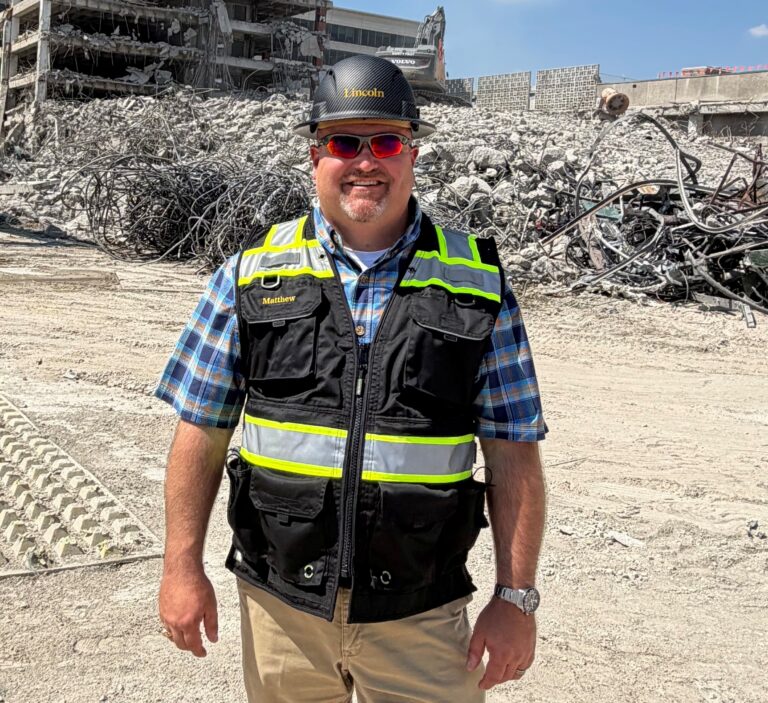
Matt Humphries
Senior Project Manager
Construction Management Department